
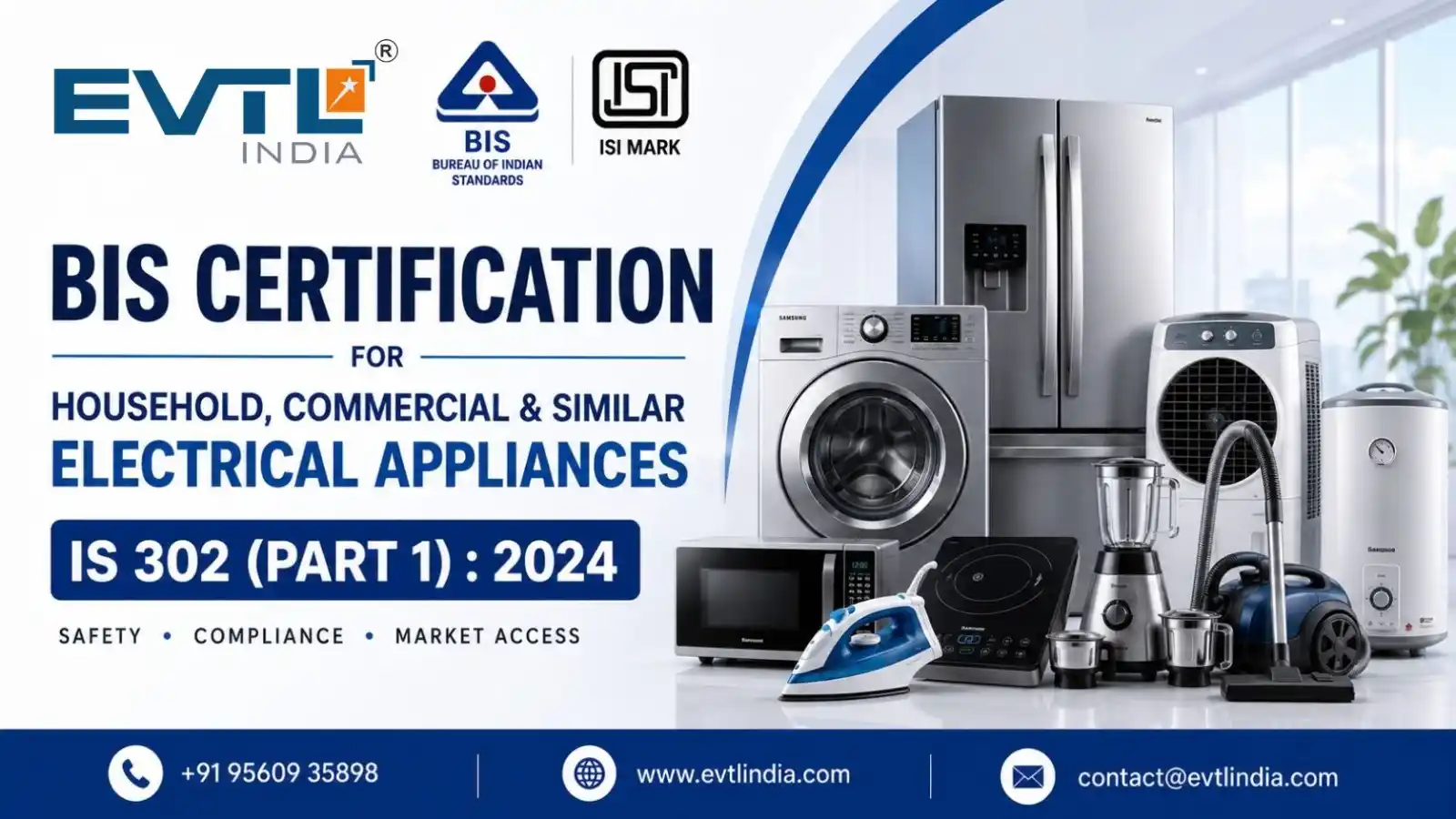
BIS Certification for Household, Commercial and Similar Electrical Appliances IS 302 (Part 1) : 2024
Overview of IS 302 (Part 1): 2024
- Safe from electrical shocks, overheating, and fire hazards
- Reliable for use in homes, offices, hotels, shops, and similar environments
- Designed and manufactured according to established safety requirements
- Tested for electrical, mechanical, thermal, and functional safety
- Equipped with appropriate insulation, protection, and safety features
- Consistent in quality, performance, and compliance with Indian safety standards
- Suitable for safe operation under normal and reasonably foreseeable conditions
- Manufactured in accordance with updated national and international safety practices
What is BIS Certification for Home Appliances
The Bureau of Indian Standards (BIS) is India’s national authority responsible for formulating and enforcing product quality and safety standards. BIS Certification Home Appliances confirms that the product complies with IS 302 (Part 1): 2024, the Indian Standard that specifies the general safety requirements for household, commercial, and similar electrical appliances to ensure safe construction, operation, and performance. Manufacturers who obtain ISI Certification for Home Appliances are authorized to display the ISI mark on their products. This mark is a trusted symbol that assures consumers, distributors, and regulators that the appliance has undergone rigorous testing and factory inspection. A valid BIS License for Home Appliances demonstrates full compliance with Indian regulatory requirements.
The Household, Commercial and Similar Electrical Appliances Safety (Quality Control) Order, 2026 has been issued by the Department for Promotion of Industry and Internal Trade (DPIIT) under the provisions of the Bureau of Indian Standards (BIS) Act, 2016. The main objective of this order is to ensure that electrical appliances used in homes, commercial establishments, and similar environments meet the prescribed safety requirements before they are manufactured, imported, distributed, sold, or offered for sale in India.
Scope of the QCO
The QCO applies to all electrical appliances intended for household, commercial, or similar applications with a rated voltage not exceeding 250V for single-phase appliances and 480V for other appliances, including direct-current supplied and battery-operated products. The scope covers a wide range of electrical appliances such as vacuum cleaners, cooking ranges, ovens, electric water boilers, coffee makers, dishwashers, commercial kitchen equipment, air-cleaning appliances, humidifiers, personal care devices, water-heating appliances, and various battery-operated electrical products.
Applicable Indian Standard
Under this Quality Control Order, all covered products must comply with IS 302 (Part 1): 2024 / IEC 60335-1:2020 – Household and Similar Electrical Appliances – Safety – Part 1: General Requirements. Manufacturers are required to obtain BIS certification and use the Standard Mark under the applicable conformity assessment scheme to demonstrate compliance with the prescribed safety requirements.
Implementation Timeline
- 1 October 2026 – Applicable to all manufacturers other than Micro and Small Enterprises (MSEs).
- 1 January 2027 – Applicable to Small Enterprises as defined under the MSMED Act, 2006.
- 1 April 2027 – Applicable to Micro Enterprises as defined under the MSMED Act, 2006.
- Certification Authority – The Bureau of Indian Standards (BIS) will serve as the certification and enforcement authority for products covered under this Quality Control Order.
- Mandatory Compliance – Manufacturers must obtain BIS certification and use the applicable Standard Mark before the covered products can be manufactured, imported, sold, distributed, or offered for sale in India.
Products Covered under IS 302 (Part 1): 2024
BIS Certification Process for Electrical Appliances
TheISI certification for home appliances involves several steps to verify that products comply with applicable standards:
- Application Submission: Manufacturers submit the BIS application form, including technical product details.
- Product Testing: Samples are tested in BIS-approved laboratories against IS 302 (Part 1): 2024, focusing on safety, performance, and durability.
- Factory Inspection: BIS officials inspect the manufacturing facility to assess production processes and quality control systems.
- Evaluation of Test Reports: BIS evaluates the lab test results. Products meeting all standards are approved for certification.
- Grant of License: Upon approval, the BIS license is issued, allowing manufacturers to use the ISI Mark for electrical home appliances.
- Surveillance: Post-certification, BIS conducts periodic audits and random sample testing to ensure continued compliance.
Documents Required for BIS Certification
The documents required for BIS certification include:
- Application form
- Manufacturing process details
- Quality control plan
- Test reports from BIS-approved laboratories
- Factory layout and equipment details
- Proof of business registration
- Product specifications and technical details
- Declaration of conformity to Indian standards
Having these documents in order is crucial for a smooth certification process. Missing or incorrect documentation can lead to delays or rejection of the application.
Why the BIS Quality Control Order (QCO) 2025 Matters
The introduction of the Safety of Household, Commercial, and Similar Electrical Appliances (Quality Control) Order, 2025 underscores the government’s focus on consumer safety and product quality. By enforcing compliance with IS 302 (Part 1): 2024, the QCO significantly reduces risks associated with electrical accidents and ensures the reliability of appliances in the market.
Exemptions and grace periods are available for small and micro enterprises, providing them with 9 and 12 months, respectively, to comply with the new regulations. Manufacturers can also import up to 200 units annually for research and development without requiring certification, provided the appliances are not sold commercially.
How BIS Consultants and Agents Help
The certification process for Electric Home Appliances under IS 302 (Part 1): 2024 can be complex and documentation-intensive. Professional assistance helps manufacturers complete the process smoothly and maintain compliance.
- BIS Consultant for Home Appliances: Assists with documentation, application filing, product testing, and overall BIS compliance.
- ISI Consultant for Home Appliances: Guides manufacturers in meeting IS 302 (Part 1): 2024 requirements and obtaining the ISI Mark.
- BIS Agent for Home Appliances: Coordinates with BIS authorities, schedules factory inspections, and manages certification-related communication.
With expert guidance, manufacturers can minimize delays, avoid compliance issues, and obtain BIS certification more efficiently.
Conclusion:
Navigating the BIS certification for home appliances can be challenging due to technical requirements, document management, and strict testing protocols. EVTL India, a leading BIS certification consultant, provides comprehensive support to manufacturers seeking the ISI Mark for home appliances or other electrical devices.
From application submission to product testing and certification, EVTL India’s expert team simplifies the process, ensuring compliance with the Safety of Household, Commercial, and Similar Electrical Appliances (Quality Control) Order, 2025. Whether you’re a small business or a large manufacturer, EVTL India ensures your products meet all necessary standards, providing a hassle-free experience and helping you achieve market success.