
BIS Certification for AAC Blocks (Autoclaved Cellular Concrete) IS 2185 (Part 3):1984
In today’s era of sustainable and
efficient construction, Autoclaved Aerated Concrete (AAC) blocks have become a
preferred building material due to their lightweight, eco-friendly, and
high-performance characteristics. These blocks are widely used in residential,
commercial, and industrial structures for their excellent thermal insulation, fire
resistance, soundproofing, and ease of handling.
To regulate the quality, safety, and performance of AAC blocks used across India, the Bureau of Indian Standards (BIS) has specified norms under the IS 2185 (Part 3):1984. BIS certification under this standard ensures that AAC blocks meet defined criteria for dimensions, compressive strength, density, and durability, making them suitable for safe and reliable construction.
What Are AAC Blocks?
Autoclaved Aerated Concrete (AAC)
blocks, also known as Autoclaved Cellular Concrete, are precast, lightweight
concrete masonry units. They are made using cement, lime, silica-rich materials
(such as fly ash or sand), water, and aluminum powder (as an expanding agent).
The reaction between aluminum powder and lime generates hydrogen gas, creating
millions of microscopic air bubbles. Once the material is set, it is autoclaved
(steam-cured under pressure) to harden and form a strong, lightweight block
with a cellular structure.
ACC blocks are widely used in construction because of various advantages like lightweight, superior thermal insulation, excellent fire resistance, acoustic performance, eco-friendliness, faster construction, pest resistance, and durability. These features make AAC blocks a sustainable choice for green buildings, affordable housing, and modern high-rises.
IS 2185 (Part 3):1984 –
The Standard for AAC Blocks
The Indian Standard IS 2185 (Part 3):1984 defines the specifications for Autoclaved Cellular
Concrete (ACC or AAC) masonry units, ensuring quality, uniformity, and
performance for construction applications.
Key Provisions
of the Standard:
The standard ensures that blocks perform well in load-bearing and non-load-bearing construction.
Why BIS Certification is
Mandatory for AAC Blocks
BIS certification is crucial to:
The ISI Mark issued by BIS is a symbol of trust, quality, and regulatory compliance.
Key Tests Conducted for
BIS Certification of AAC Blocks
To obtain BIS certification,
manufacturers must undergo rigorous testing and quality assessment. The
following tests are performed as per IS
2185 (Part 3):1984:
● Dimensions and Tolerance Test
● Dry Density Test
● Compressive Strength Test
● Drying Shrinkage Test
● Thermal Conductivity Test
● Water Absorption Test
● Sound Insulation Performance
● Moisture Movement & Warping
Tests
● Workability and Surface Finish
Assessment
All testing must be carried out in BIS-recognized laboratories.
BIS Certification Process for AAC Blocks

Here’s a simplified view of the BIS
certification procedure:
- Application Filing: Submit a detailed application to BIS with factory and product details.
- Factory Inspection: BIS officials inspect the production process, testing setup, and quality control measures.
- Sample Collection: Product samples are taken for third-party lab testing.
- Test Report Review: BIS reviews the results for compliance with IS 2185 (Part 3):1984.
- License Grant: On successful evaluation, BIS issues the license to use the ISI mark.
- Surveillance Audits: Regular checks to ensure ongoing compliance and product consistency.
To Know The Process in Detail, Please Visit:
Under BIS Registration Products ISI and CRS
Documents Required for BIS Certification
To apply for BIS certification, manufacturers need to submit the following documents:
● Application form
● Manufacturing process details
● Quality control plan
● Test reports from BIS-approved laboratories
● Factory layout and equipment details
● Proof of business registration
● Product specifications and technical details
● Declaration of conformity to Indian standards
Additionally, manufacturers may be required to provide proof of compliance with environmental and safety regulations, depending on the specific type of product being certified.
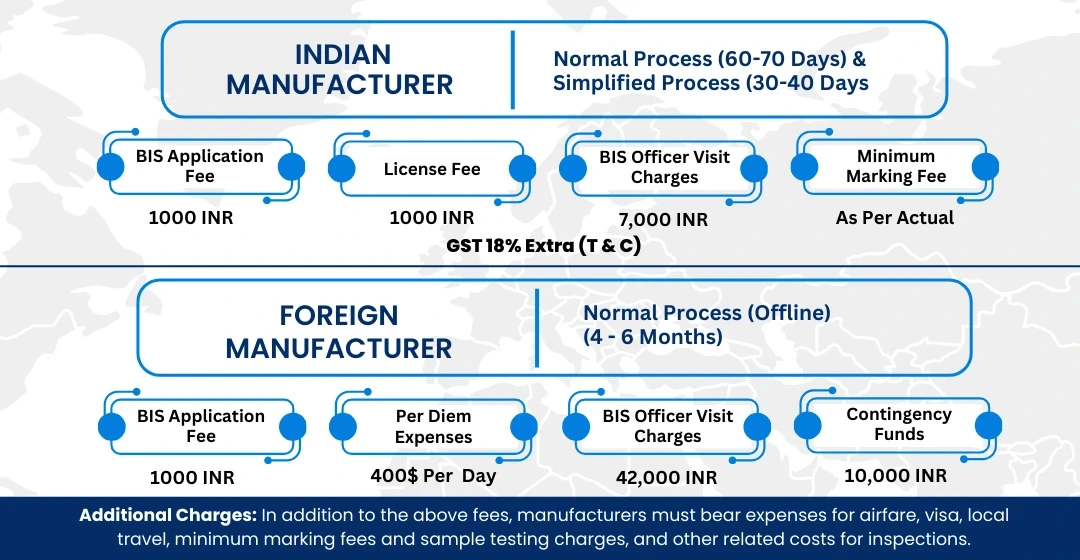
BIS ISI Mark Certification Costing And Timeline
EVTL India – Your Expert
Partner for BIS Certification
Navigating the BIS certification
process can be complex, but that’s where EVTL
India comes in.
We offer end-to-end support for manufacturers of AAC blocks, including:
With deep domain expertise and a hands-on approach, we help fast-track your certification and bring your AAC blocks to market with full compliance and confidence.
Conclusion
Autoclaved Aerated Concrete (AAC)
blocks represent the future of sustainable and energy-efficient construction in
India. However, ensuring product quality and standardization is critical for
the safety, durability, and credibility of any construction project.
BIS Certification under IS 2185 (Part
3):1984 is not just a legal requirement – it’s a mark of trust, quality, and
safety.