
BIS Certification for Adapter and Withdrawal Sleeves IS 16605 (Part 1):2018
In industrial machinery, rolling bearings
are integral components that ensure efficient rotational motion with minimal
friction. However, equally important to the function and longevity of these
bearings are the accessories that support their secure
installation—particularly adapter sleeves and withdrawal sleeves.
These accessories are critical for mounting bearings with tapered bores onto cylindrical shafts, ensuring proper alignment, secure fitment, and ease of maintenance.
To ensure consistent quality, safety, and dimensional accuracy, the Bureau of Indian Standards (BIS) has introduced IS 16605 (Part 1):2018, an Indian Standard aligned with ISO 2982-1:2013. It specifies the boundary dimensions and tolerances for adapter sleeve assemblies and withdrawal sleeves, setting a uniform benchmark for manufacturers, suppliers, and end-users.
Understanding Adapter
Sleeves and Withdrawal Sleeves
Adapter Sleeves are used to mount
bearings with tapered bores onto plain cylindrical shafts. These sleeves are
supplied as complete assemblies, typically including a lock nut and locking device
such as a washer or clip. They simplify mounting and dismounting processes
while allowing axial positioning adjustments of the bearing on the shaft.
Withdrawal Sleeves, on the other hand,
are used for mounting bearings on stepped shafts. These are pressed beneath the
inner ring of the bearing and allow the bearing to be withdrawn without causing
damage. The thread required for a lock nut is located on the larger cone diameter of the sleeve.
However, unlike adapter sleeves, lock
nuts and locking devices are not supplied with withdrawal sleeves and must
be procured separately.
These components are widely used across sectors like electric motors, gearboxes, pumps, compressors, and heavy machinery where precise bearing installation and removal are essential for equipment performance and maintenance.
IS 16605 (Part 1):2018 –
Overview of the Standard
The Indian Standard IS 16605 (Part 1):2018, which adopts
the international standard ISO
2982-1:2013, focuses on the dimensions
and compatibility of adapter sleeves and withdrawal sleeves. It ensures
that these bearing accessories conform to precise mechanical and dimensional
specifications that facilitate interchangeability and safe usage.
Key Features
of the Standard:
This standard not only promotes dimensional conformity but also facilitates global trade by ensuring Indian products meet internationally recognized specifications.
Mandatory BIS
Certification under Quality Control Order, 2025
To reinforce quality assurance across
the bearing components industry, the Ministry of Commerce and Industry has
introduced the Bearing Components and Accessories (Quality Control) Order,
2025. Under this order, products categorized as "Rolling Bearings
Accessories Dimensions for Adapter Sleeve Assemblies and Withdrawal
Sleeves" must comply with IS 16605 (Part 1):2018.
What This
Means for Manufacturers:
This move aims to eliminate substandard products from the market, improve user confidence, and align domestic manufacturing with global quality norms.
Certification Process for Manufacturers

To obtain BIS certification for
adapter sleeves and withdrawal sleeves under IS 16605 (Part 1):2018,
manufacturers must undergo a structured assessment, which includes:
- Application Filing with BIS, along with documentation of product specifications and quality control procedures.
- Factory Audit conducted by BIS officials to inspect the manufacturing process and ensure compliance with safety and quality requirements.
- Product Testing, where samples are tested at BIS-recognized laboratories for dimensional accuracy, fitment, and performance benchmarks.
- License Issuance, upon successful audit and test results, allowing the manufacturer to use the Standard Mark.
- Ongoing Surveillance to ensure that compliance is maintained through periodic inspections and product testing.
To Know The Process in Detail, Please Visit:
Under BIS Registration Products ISI and CRS
Documents Required for BIS Certification
To apply for BIS certification, manufacturers need to submit the following documents:
● Application form
● Manufacturing process details
● Quality control plan
● Test reports from BIS-approved laboratories
● Factory layout and equipment details
● Proof of business registration
● Product specifications and technical details
● Declaration of conformity to Indian standards
Additionally, manufacturers may be required to provide proof of compliance with environmental and safety regulations, depending on the specific type of product being certified.
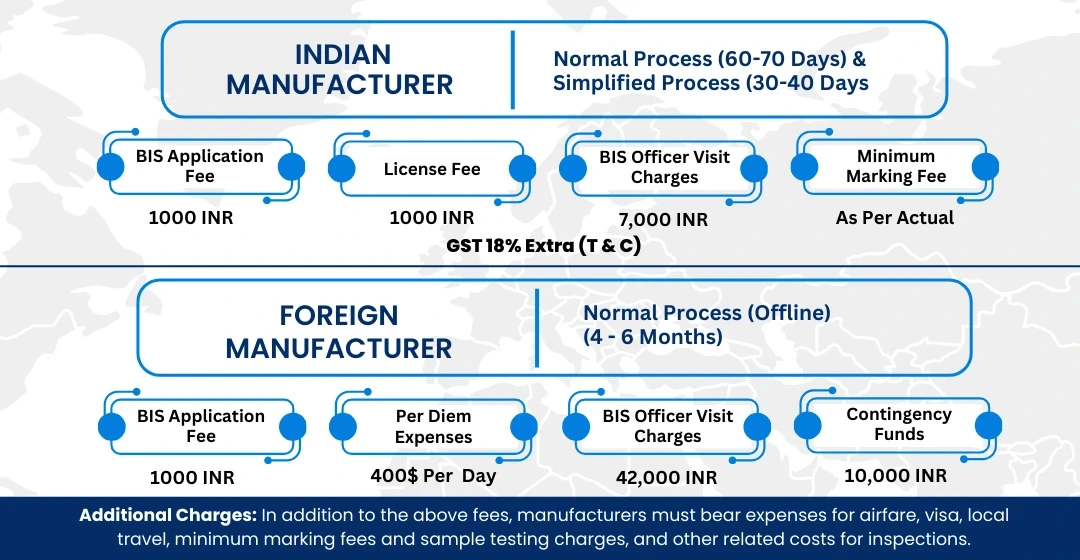
BIS ISI Mark Certification Costing And Timeline
Why BIS Certification Matters
For manufacturers, obtaining BIS
certification is not just a regulatory requirement—it is a competitive
advantage. It affirms a commitment to quality, facilitates access to both
domestic and international markets, and builds customer trust.
For consumers and industry buyers, the
ISI mark serves as a reliable indicator of product quality, safety, and compatibility.
It ensures that the rolling bearing accessories they purchase will perform
reliably under demanding operational conditions.
Additionally, BIS certification supports the broader goals of standardization, safety, and Make in India initiatives, contributing to India's growing reputation as a center for high-quality industrial manufacturing.
Conclusion
Adapter and withdrawal sleeves are
small components that play a big role in the efficiency and reliability of
rolling bearings in critical applications. With the implementation of IS 16605 (Part 1):2018 under the Quality Control Order, 2025, the
Government of India is ensuring that these essential components meet the
highest standards of precision and performance.
BIS certification not only protects
end-users from substandard products but also empowers Indian manufacturers to
thrive in a competitive, quality-driven market.