
BIS Certification for Flameproof Enclosures in Explosive Atmospheres IS/IEC 60079-1:2014
In industrial environments where
explosive gases or vapors are present, safety is not optional—it is an absolute
necessity. One of the most critical safety components in such hazardous
locations is the flameproof enclosure,
also known as an "Ex d"
enclosure. These enclosures are engineered to prevent explosions from
spreading outside the equipment, ensuring that the surrounding atmosphere
remains unaffected even in the event of an internal ignition.
To regulate and standardize the safety requirements of such equipment, the Bureau of Indian Standards (BIS) has adopted the globally recognized IS/IEC 60079-1:2014, titled “Explosive Atmospheres – Part 1: Equipment Protection by Flameproof Enclosures ‘d’.” This standard provides the design principles, construction guidelines, and testing methodologies to ensure the safe use of electrical apparatus in potentially explosive gas environments.
What Are Flameproof
Enclosures?
Flameproof enclosures are specially
designed housings for electrical or electronic equipment used in Zone 1 and Zone 2 hazardous areas where
flammable gases or vapors may exist. These enclosures are constructed to withstand an internal explosion and
prevent the transmission of flames or hot gases to the external environment.
The underlying principle is that if an explosion occurs within the enclosure, it will be contained, and the structure of the enclosure will prevent it from igniting the surrounding explosive atmosphere. This is achieved through precise mechanical design, including flamepaths, joint clearances, robust material selection, and pressure-resistance characteristics.
Industrial Relevance
Flameproof enclosures are essential in
industries where the risk of gas or vapor ignition can result in catastrophic
consequences. They are commonly used in:
In these environments, standard electrical equipment is not suitable. Only certified flameproof equipment can be deployed to maintain safety and regulatory compliance.
Role of BIS and IS/IEC
60079-1:2014
The Bureau of Indian Standards mandates compliance with IS/IEC 60079-1:2014 for manufacturers
who intend to supply flameproof electrical enclosures in the Indian market. The
standard is harmonized with international norms under the IEC 60079 series, ensuring compatibility with global safety
protocols.
IS/IEC 60079-1:2014 details the minimum requirements for the design,
construction, inspection, and testing of flameproof enclosures. It covers
aspects such as:
By obtaining BIS certification under this standard, manufacturers demonstrate that their product is capable of safely operating in explosive atmospheres and is legally approved for use across Indian industrial installations.
Tests Conducted Under
IS/IEC 60079-1:2014
The performance of flameproof
enclosures is validated through a series of mechanical, thermal, and structural tests that simulate real-world
explosion scenarios and mechanical impacts. These include:
These tests ensure that the enclosure will function reliably under adverse conditions and maintain its explosion-containment capability over time.
BIS Certification Process

To secure BIS certification for
flameproof enclosures under IS/IEC 60079-1:2014, manufacturers must follow a
structured process:
- Application Filing: Submit detailed documentation about the product design, materials, technical drawings, and manufacturing process.
- Testing: The product undergoes rigorous testing at a BIS-recognized laboratory to evaluate compliance with the standard.
- Factory Audit: BIS officials inspect the production facility to verify quality control systems and process adherence.
- Certification Grant: Upon successful testing and inspection, BIS issues a license that allows the product to carry the ISI mark.
- Surveillance and Renewal: Regular surveillance audits and retesting ensure ongoing compliance.
To Know The Process in Detail, Please Visit:
Under BIS Registration Products ISI and CRS
Documents Required for BIS Certification
To apply for BIS certification, manufacturers need to submit the following documents:
● Application form
● Manufacturing process details
● Quality control plan
● Test reports from BIS-approved laboratories
● Factory layout and equipment details
● Proof of business registration
● Product specifications and technical details
● Declaration of conformity to Indian standards
Additionally, manufacturers may be required to provide proof of compliance with environmental and safety regulations, depending on the specific type of product being certified.
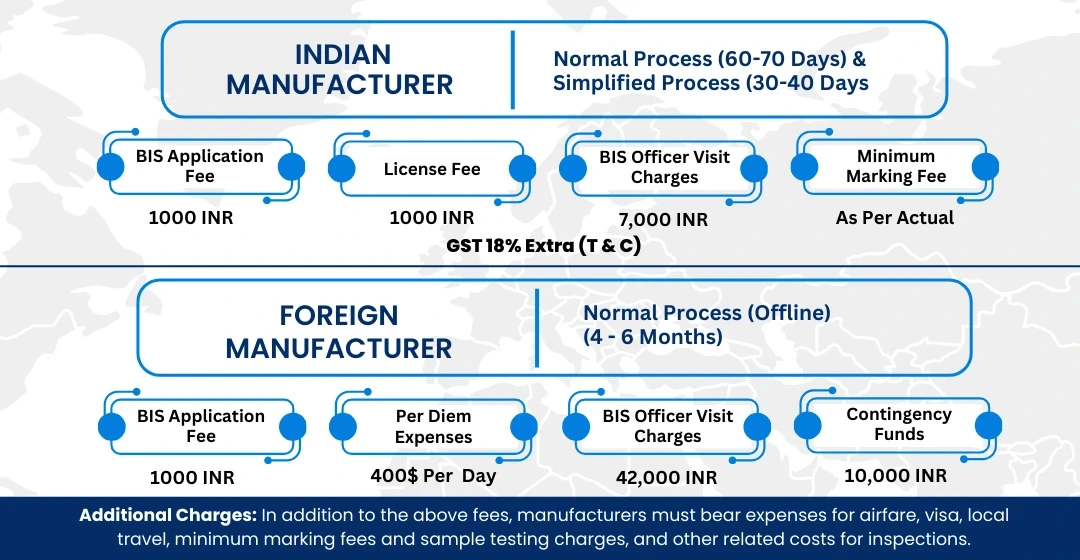
BIS ISI Mark Certification Costing And Timeline
Importance of BIS Certification
BIS certification for flameproof
enclosures is more than a regulatory requirement—it is a commitment to
industrial safety and quality assurance. Certified equipment helps:
Without this certification, manufacturers may be barred from selling or installing their products in critical sectors like oil, gas, mining, and chemical industries.
How EVTL India Can Help
Navigating the BIS certification
process, especially for a technically intensive product like a flameproof
enclosure, can be complex. EVTL India offers end-to-end support—from
documentation and test coordination to BIS liaison and compliance consulting.
Whether you're a domestic manufacturer or an international supplier entering the Indian market, our team ensures that your equipment meets all necessary design, testing, and regulatory benchmarks under IS/IEC 60079-1:2014.
Conclusion
Safety in explosive atmospheres begins
with compliant equipment. BIS certification of flameproof enclosures under IS/IEC 60079-1:2014 is a critical
safeguard that ensures electrical systems used in hazardous zones are robust,
secure, and reliable. For manufacturers, it represents a commitment to quality;
for industries, it means trust and safety; and for end users, it offers peace
of mind.