
BIS Certification for Injection Moulded/Machined HDPE Fittings for Potable Water Supplies IS 8008 Part 1
In the realm of potable water infrastructure, the importance of safe, durable, and standardized components cannot be overstated. Among these components, High Density Polyethylene (HDPE) fittings play a vital role in ensuring leak-proof, corrosion-resistant water supply systems. To maintain product quality and public health, the Bureau of Indian Standards (BIS) mandates certification for such fittings under IS 8008 (Part 1).
Let’s explore the significance of BIS certification, the scope of IS 8008 (Part 1): General Requirements, and what manufacturers need to know to achieve compliance.
What is IS 8008 (Part 1)?
IS 8008 (Part 1): 2008 specifies the general requirements for injection-moulded or machined HDPE fittings used in potable water supply systems. These fittings are intended for use in conjunction with polyethylene (PE) pipes made from materials conforming to IS 4984. The standard covers Types and dimensions of fittings (like elbows, tees, reducers, end caps), material requirements, workmanship and finish, physical and mechanical properties, test methods, and marking and labeling.
Scope of the Standard –
General Requirements (Part 1)
IS 8008 (Part 1) outlines broad
criteria applicable to all HDPE fittings, regardless of their specific use
case. Some of the key requirements include:
1. Material Compliance: Fittings
must be made from HDPE material that meets the properties defined in IS 4984.
This includes resistance to environmental stress cracking, impact strength, and
chemical resistance.
2. Manufacturing Quality: Fittings
must be free from defects such as bubbles, cracks, or voids. The finish must be
smooth and uniform, ensuring easy and secure jointing.
3. Dimensional Accuracy: Each
type of fitting must adhere to specified dimensional tolerances to ensure
compatibility with PE pipes and consistent water flow.
4. Mechanical Properties: Fittings
are tested for Hydrostatic pressure resistance, Tensile strength, and
Elongation at break.
5. Marking and Labelling: Each fitting must bear the Manufacturer's name or trademark, Nominal diameter, Batch number or code, and ISI mark (after certification).
Why BIS Certification is
Important
BIS certification, under the
Compulsory Registration Scheme (CRS) or ISI Mark scheme, ensures that the
product conforms to the Indian Standard and meets the necessary safety,
quality, and performance criteria. For HDPE fittings for potable water:
● It assures consumers and
regulators of product reliability.
● It is mandatory for
manufacturers and importers intending to sell in the Indian market.
● It helps in standardizing product quality across suppliers, enhancing public health, and infrastructure longevity.
BIS Certification Process
for HDPE Fittings
The process for obtaining ISI
certification for HDPE Fittings for portable water supplies involves the
following steps:
- Application
Submission: Submit the completed application
form with necessary documentation to BIS.
- Document Review: BIS evaluates the submitted documents to verify accuracy and
completeness.
- Factory Inspection: BIS officials conduct on-site inspections to assess
manufacturing processes and quality control systems.
- Sample Testing: Product samples are collected and tested at BIS-approved
laboratories to verify compliance with Indian standard.
- Certification Grant: Upon successful inspection and testing, the BIS issues the certification, allowing the use of the ISI Mark.

Documents Required for BIS Certification
To apply for ISI
Certification for HDPE Fittings for portable water supplies, manufacturers must
provide the following documents:
● Completed application form
● Detailed manufacturing process
information
● Quality control plans and test
reports
● Factory layout and equipment
details
● Product specifications and
technical details
● Business registration proof
● Declaration of conformity to
Indian standards
Additional documentation may be required based on product specifications and environmental regulations.
BIS ISI Mark Certification Costing And Timeline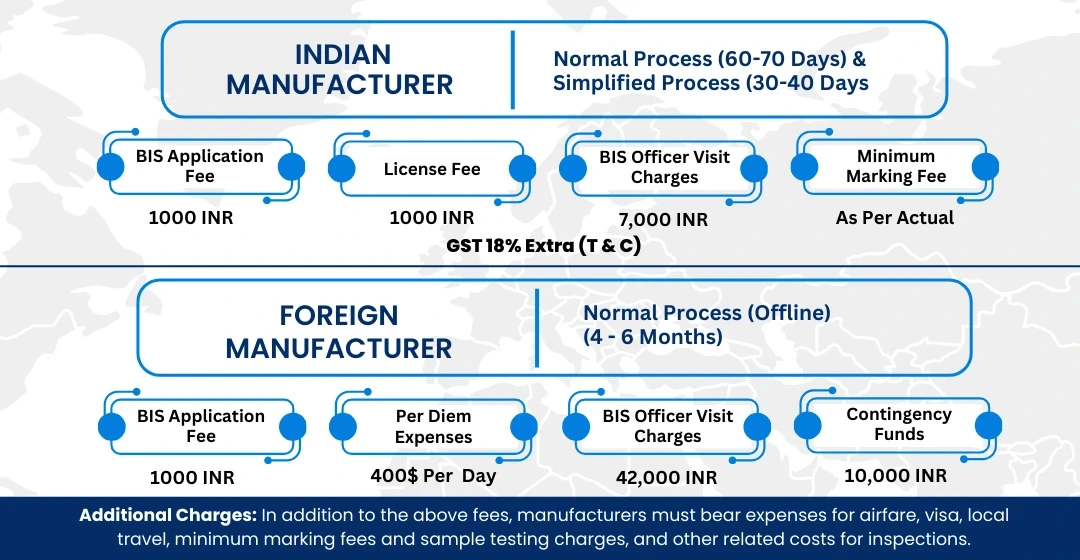
To Know The Process in Detail, Please Visit:
Under BIS Registration Products ISI and CRS
Conclusion
For manufacturers and suppliers of
HDPE fittings used in potable water systems, compliance with IS 8008 (Part 1) is not just a
regulatory requirement—it is a mark of commitment to quality and public safety.
The BIS certification process
ensures that products reaching the market meet stringent Indian standards,
helping to build trust among consumers and authorities alike.
Whether you're a new entrant or an
established player in the water infrastructure sector, understanding and
obtaining BIS certification is a critical step in ensuring long-term success
and credibility. Need help with BIS certification or technical consultation for
IS 8008? Let us know—we’re here to guide you through every step!