
BIS Certification for Insulated Food Storage Containers IS 17569:2021
In today’s fast-paced lifestyle,
insulated food storage containers have become an essential household and
commercial utility. Whether it’s for packed lunches, food delivery services, or
preserving leftovers, these containers help maintain food temperature over
extended periods, keeping hot meals hot and cold items cool. With the growing
consumer demand for safer, more efficient food containers, ensuring the quality and thermal performance of such
products is crucial.
To standardize and regulate these products, the Bureau of Indian Standards (BIS) has introduced IS 17569:2021, which mandates BIS certification for insulated containers meant for food storage in India. This standard outlines stringent criteria for safety, thermal efficiency, durability, and material quality.
What is IS 17569:2021?
IS 17569:2021 is the Indian Standard
that specifies the constructional,
material, and performance requirements for insulated containers used for storing and transporting food. These
containers are designed with a double-walled construction and insulation in
between—typically using vacuum insulation, PU foam, or other insulating
materials—to reduce heat transfer and maintain food at the desired temperature
for longer durations.
The standard applies to a wide range of containers, including Lunch boxes, Jars, Multi-compartment containers, Hot and cold boxes with inserts, Thermoware containers used for commercial food services, and more. The goal of this standard is to ensure that such containers are thermally efficient, leak-proof, structurally durable, and safe for food contact.
Types of Insulated
Containers Covered
Under IS 17569:2021, containers are
classified based on the material
composition of their internal and external walls, lid design, and inserts.
These include:
These containers may feature handles, shoulder straps, or locking mechanisms to improve portability and functionality, especially for outdoor or delivery use.
Why BIS Certification is
Mandatory
The BIS certification ensures that insulated food containers meet the
required safety, hygiene, and performance benchmarks. This not only protects
consumers from substandard products but also ensures that the containers do not
leach harmful substances into the food, maintain temperature as claimed, and
remain robust during transport or rough handling.
Key benefits of BIS certification:
Key Performance Parameters
and Tests Conducted
IS 17569:2021 mandates a wide range of
laboratory and mechanical tests to
validate the quality and performance of insulated containers. These tests
simulate real-world usage conditions and assess various functional aspects.
Major Tests
Include:
● Minimum Thickness of Plastic
● Coating Thickness (if
applicable)
● Capacity Check
● Heat Retention Capability
● Cold Retention Capability
● Drop Impact Test
● Pendulum Impact Test
● Fixing Strength of the Handle
● Strength of Shoulder Strap (if
applicable)
● Leakage Test
In addition to the above, thermal insulation tests, dimensional checks, material composition analysis, and food-contact safety evaluations are also conducted as per BIS protocols.
BIS Certification Process for Manufacturers

Manufacturers looking to sell insulated food containers in India must obtain a BIS license under IS 17569:2021. The process involves:
- Application Submission on the BIS portal with product and company details.
- Factory Audit by BIS officials to assess production capabilities and quality management systems.
- Sample Testing in a BIS-recognized laboratory.
- Grant of License, enabling use of the ISI Mark on certified products.
This certification process assures that each unit meets the minimum requirements laid down by BIS, reducing the risk of defective or substandard items entering the market.
To Know The Process in Detail, Please Visit:
- BIS ISI Mark Certification for Domestic Manufactures
- BIS ISI Mark Certification for Foreign Manufactures
Under BIS Registration Products ISI and CRS
Documents Required for BIS Certification
To apply for BIS certification, manufacturers need to submit the following documents:
● Application form
● Manufacturing process details
● Quality control plan
● Test reports from BIS-approved laboratories
● Factory layout and equipment details
● Proof of business registration
● Product specifications and technical details
● Declaration of conformity to Indian standards
Additionally, manufacturers may be required to provide proof of compliance with environmental and safety regulations, depending on the specific type of product being certified.
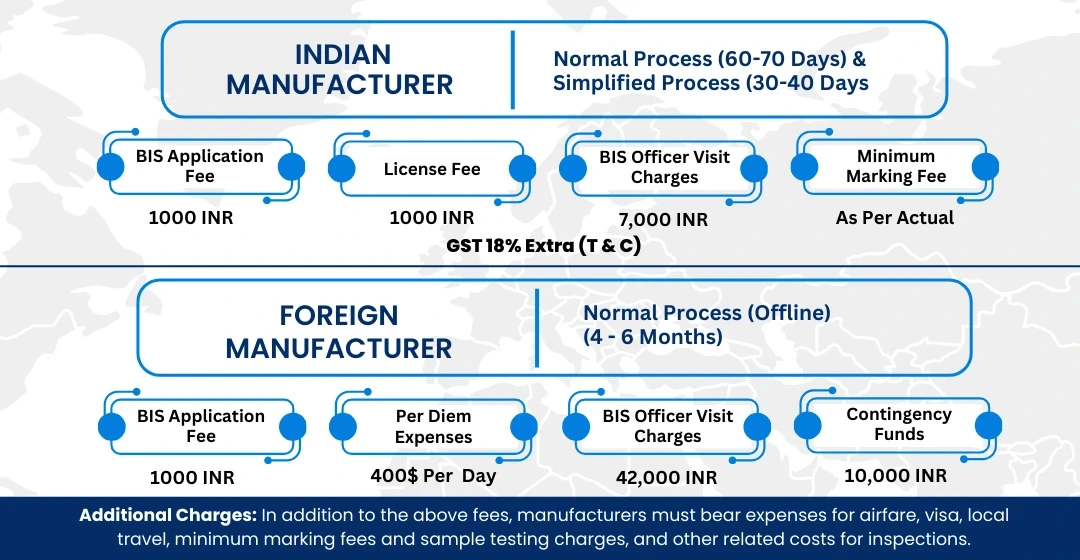
BIS ISI Mark Certification Costing And Timeline
EVTL India – Your Partner
in BIS Compliance
Navigating the BIS certification
process can be complex, particularly with stringent testing and documentation
requirements. EVTL India is a
trusted consultancy specializing in BIS
registration and compliance solutions for manufacturers and importers.
We offer end-to-end support,
including:
Our experts ensure that your insulated containers meet all regulatory standards under IS 17569:2021, helping you enter the Indian market with confidence.
Conclusion
With the increasing demand for
thermally efficient, durable, and food-safe insulated containers, compliance with IS 17569:2021 is no longer
optional—it’s essential. BIS certification guarantees that consumers receive
products that are safe, reliable, and capable of maintaining food temperature
as claimed.
Whether you’re a domestic manufacturer
or an overseas exporter looking to supply insulated containers in India, EVTL India is your ideal BIS
certification partner to help you achieve compliance quickly and efficiently.