BIS Certification for Outdoor/Indoor Type Liquid Immersed Distribution Transformers IS 1180 (Part 3)
In today’s power distribution
networks, distribution transformers serve as the final voltage transformation
stage before electricity reaches end consumers. With an increasing demand for
eco-friendly, safer, and high-performance transformer solutions,
liquid-immersed transformers using natural or synthetic ester liquids have
gained significant attention due to their enhanced fire safety,
biodegradability, and superior insulation properties.
To ensure quality and safety, the
Bureau of Indian Standards (BIS) has introduced IS 1180 (Part 3) — a
specialized standard for Outdoor/Indoor Type Liquid Immersed Distribution
Transformers up to and including 2500 kVA, 33 kV, using natural/synthetic
organic ester insulating liquids.
Let’s explore the scope and requirements of IS 1180 (Part 3), the BIS certification process, and why manufacturers and suppliers must comply with this Indian Standard for sustainable and safe transformer deployment.
Indian Standard IS 1180
(Part 3)
IS 1180 (Part 3):
2023 is the Indian Standard that specifies the technical and performance
requirements for distribution transformers immersed in natural or synthetic
organic ester fluids. These transformers are designed for voltages up to 33 kV
and capacities up to 2500 kVA. They are suitable for both indoor and outdoor
installations and provide enhanced fire safety due to the high fire point of
ester fluids. Additionally, they offer improved environmental performance
through biodegradability and efficient insulation due to their excellent
dielectric properties. This standard complements the existing IS 1180 series,
which covers mineral oil-immersed transformers, thereby expanding India's
regulatory framework to incorporate sustainable insulation technologies. The
standard outlines stringent construction, performance, and testing criteria for
ester-immersed distribution transformers:
- Rated Capacity and
Voltage: Designed for capacities up to 2500
kVA and primary voltages up to 33 kV, these transformers are suitable for
three-phase applications.
- Insulating Liquid
Requirements: The use of natural esters (vegetable-based)
or synthetic organic esters is required, which must comply with IS 16081
or equivalent IEC standards. The ester fluids must have a high fire point
(greater than 300°C), high moisture tolerance, and biodegradability.
- Cooling and Mounting: These transformers utilize ONAN type cooling (Oil Natural Air
Natural) and are suitable for both pole-mounted and pad-mounted
installations.
- Efficiency and
Losses: The transformers must meet the energy
efficiency levels defined by the Bureau of Indian Standards (BIS) and
comply with minimum loss values for different kVA ratings.
- Type Tests and
Routine Tests: Required tests include
temperature rise tests, lightning impulse tests, short-circuit withstand
tests, insulation resistance tests, and dissolved gas analysis of the
ester fluid.
- Marking and Nameplate Details: Certified transformers must prominently display the manufacturer's name, serial number, BIS license number, standard number (IS 1180 (Part 3)), and the ISI mark.
Why BIS Certification is
Mandatory
As part of India’s commitment to
electrical safety, quality, and environmental sustainability, BIS certification
is mandatory for manufacturers of
distribution transformers covered under IS 1180 (Part 3).
BIS
Certification Ensures:
● Compliance with safety and
energy efficiency norms
● Reliability under Indian grid
and climatic conditions
● Eligibility for government and
utility tenders
● Usage of BIS-approved natural
or synthetic ester liquids
● Long-term durability and
reduced risk of fire
The ISI mark signifies adherence to national standards and gives end users, including power utilities and infrastructure developers, confidence in transformer performance and safety.
BIS Certification Process
for IS 1180 (Part 3)
Here’s a step-by-step guide for
manufacturers seeking ISI certification
for ester-immersed distribution transformers:
- Application
Submission: Submit the completed application
form with necessary documentation to BIS.
- Document Review: BIS evaluates the submitted documents to verify accuracy and
completeness.
- Factory Inspection: BIS officials conduct on-site inspections to assess
manufacturing processes and quality control systems.
- Sample Testing: Product samples are collected and tested at BIS-approved
laboratories to verify compliance with Indian standards.
- Certification Grant: Upon successful inspection and testing, the BIS issues the certification, allowing the use of the ISI Mark.

Documents Required for BIS Certification
To apply for ISI Certification for Fire Doors and Assembly, manufacturers must provide the following documents:
● Completed application form
● Detailed manufacturing process information
● Quality control plans and test reports
● Factory layout and equipment details
● Product specifications and technical details
● Business registration proof
● Declaration of conformity to Indian standards
Additional documentation may be required based on product specifications and environmental regulations.
BIS ISI Mark Certification Costing And Timeline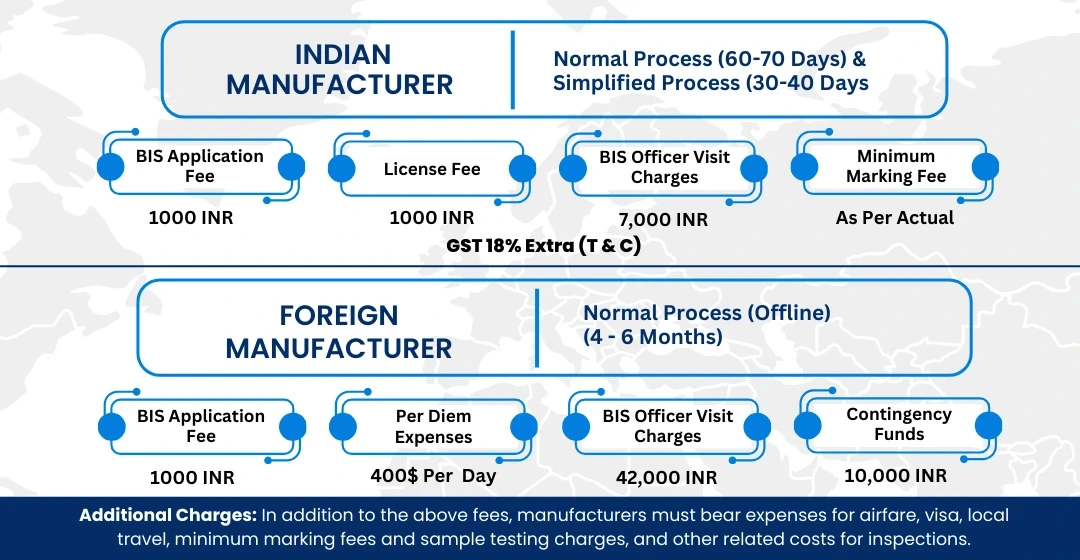
To Know The Process in Detail, Please Visit:
Under BIS Registration Products ISI and CRS
Conclusion
As India moves toward a greener,
safer, and more reliable power infrastructure, standards like IS 1180 (Part 3)
are critical in ensuring high-performance transformer technology. By obtaining
BIS certification for Liquid Immersed Distribution Transformers, manufacturers
can demonstrate compliance, unlock new markets, and contribute to sustainable
development goals.
The ISI mark is not just a regulatory requirement — it's a badge of quality, trust, and commitment to safety.
Need assistance with BIS certification under IS 1180 (Part 3)? Our experts can
help with testing, documentation, audits, and licensing. Let’s power progress —
safely and sustainably.