
BIS Certification for Plastic Crates IS 15532:2004
In the agricultural and food supply chain, plastic crates have become essential for the safe handling, storage, and transportation of fresh fruits and vegetables. Their widespread adoption has significantly improved logistics efficiency and reduced produce wastage.
Unlike traditional wooden crates or
cardboard boxes, plastic crates are lightweight, reusable, durable, and
resistant to moisture and pests, making them a preferred choice across
wholesale markets, farms, cold storage facilities, and retail outlets.
To ensure uniformity in quality and performance, the Bureau of Indian Standards (BIS) has introduced IS 15532:2004, the Indian Standard that specifies comprehensive requirements for plastic crates used for fruits and vegetables. This certification ensures that crates used in India’s fresh produce sector meet specific design, material, and strength requirements essential for their intended use.
The Role of IS 15532:2004
in Standardizing Plastic Crates
IS 15532:2004, titled “Plastic Crates for Fruits and Vegetables –
Specification”, defines the essential parameters for crates to ensure their
suitability for handling perishable agricultural produce. The standard
primarily applies to injection-molded plastic crates made from High-Density
Polyethylene (HDPE), a tough, chemically resistant material that conforms to IS
7328.
Plastic crates manufactured as per
this standard are expected to offer:
Key Requirements under IS
15532:2004
The standard provides detailed
requirements on several aspects of crate construction and performance. Some of
the critical parameters include:
Performance Tests
Conducted During BIS Certification
To assess the quality and reliability
of plastic crates, BIS mandates rigorous testing in certified laboratories.
Some of the key tests include:
Importance of BIS
Certification for Plastic Crates
BIS certification under IS 15532:2004
is more than a regulatory requirement—it's a mark of assurance for
quality-conscious buyers and government procurement agencies. A plastic crate
bearing the ISI mark has been tested and verified to comply with national
safety and performance standards.
Key benefits of BIS certification
include:
Certification Process

- Application submission with product specifications and manufacturing details
- Product sample testing at BIS-recognized laboratories to verify compliance with IS 15532:2004
- Factory inspection and audit to assess production capabilities and quality control systems
- Grant of license, allowing the use of the ISI mark on certified products
- Ongoing surveillance through periodic inspections and re-testing to ensure sustained compliance
To Know The Process in Detail, Please Visit:
Under BIS Registration Products ISI and CRS
Documents Required for BIS Certification
To apply for BIS certification, manufacturers need to submit the following documents:
● Application form
● Manufacturing process details
● Quality control plan
● Test reports from BIS-approved laboratories
● Factory layout and equipment details
● Proof of business registration
● Product specifications and technical details
● Declaration of conformity to Indian standards
Additionally, manufacturers may be required to provide proof of compliance with environmental and safety regulations, depending on the specific type of product being certified.
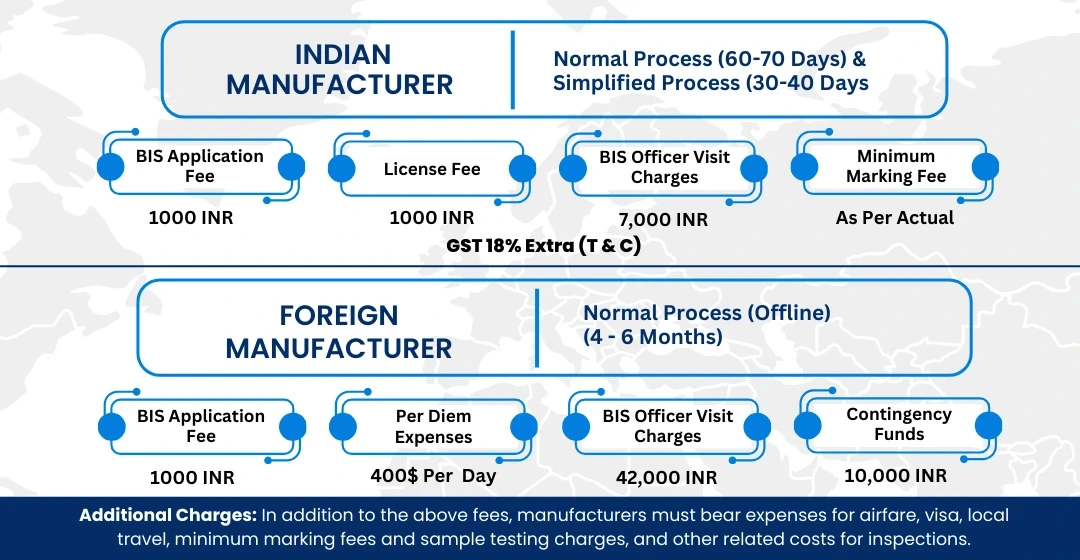
BIS ISI Mark Certification Costing And Timeline
Conclusion
In a sector where product freshness,
hygiene, and efficient handling are paramount, BIS-certified plastic crates
offer a robust solution. The IS 15532:2004 standard ensures that these crates
are manufactured to endure the rigors of daily use while protecting the
integrity of fruits and vegetables from farm to market.
Whether you are a manufacturer aiming
for market credibility or a buyer seeking reliable storage solutions, BIS
certification ensures that the plastic crates meet the highest quality and
performance benchmarks.