
BIS Certification for Room Air Conditioners, IS 1391 (Part 1): 2017
Unitary Air
Conditioners are commonly used in both residential and commercial spaces for
efficient cooling. These wall-mounted or window-mounted units are designed to
provide consistent cooling in individual rooms. IS 1391 (Part 1): 2017
specifies the standards for safety, performance, and energy efficiency for such
air conditioners.
BIS certification under this standard ensures that the units meet stringent requirements for electrical safety, cooling performance, noise levels, and energy consumption. This guarantees that consumers receive reliable, energy-efficient, and environmentally friendly products that offer optimal cooling performance while keeping operating costs low.
Introduction
BIS Certification for Room Air Conditioners under IS 1391
(Part 1): 2017 is vital for ensuring the safety, performance, and energy
efficiency of air conditioning units used in both residential and commercial
settings. Unitary air conditioners, including window units, split systems, and
packaged air conditioners, must adhere to these standards to ensure reliable
operation, reduced energy consumption, and compliance with safety regulations.
By securing BIS certification, manufacturers can demonstrate their commitment
to national safety standards, which enhances product credibility and ensures
market acceptance in India. The ISI mark reassures consumers that the product
has undergone rigorous testing and meets high-quality standards for safe and
efficient operation.
Why is BIS Certification Necessary for Unitary Air Conditioners?
BIS certification for Unitary Air Conditioners under IS 1391
(Part 1): 2017 is crucial for several important reasons. First, it ensures
consumer safety by meeting stringent standards to prevent electrical hazards,
fire risks, and unsafe refrigerant handling. Second, it promotes energy
efficiency, helping reduce electricity consumption and operational costs while
minimizing environmental impact. The certification also guarantees that the air
conditioners meet performance standards, ensuring effective cooling, airflow,
and temperature control. Additionally, it addresses environmental impact by
regulating refrigerant types to limit ozone depletion and other harmful
effects. By obtaining BIS certification, manufacturers provide quality assurance,
assuring consumers that the products are reliable, durable, and safe. Finally,
compliance with IS 1391 (Part 1): 2017 ensures legal compliance, helping
manufacturers avoid penalties under the Bureau of Indian Standards Act, 2016.
Also Read
BIS QCO for Unitary Air ConditionersOverview of Indian Standard IS 1391 (Part 1): 2017
IS 1391 (Part 1): 2017 specifies key requirements for Unitary
Air Conditioners, ensuring their safe and efficient operation in rooms. The
standard outlines cooling performance criteria, ensuring that the unit provides
adequate cooling capacity, efficient temperature control, and optimal airflow
for the designated space. It mandates strict electrical safety measures to
prevent electrical shocks, fires, and short circuits, with guidelines for
insulation, grounding, and component protection. To promote energy savings, the
standard includes energy efficiency requirements, such as EER (Energy
Efficiency Ratio) and ISEER (Indian Seasonal Energy Efficiency Ratio), helping
consumers select energy-efficient units. The standard also sets noise level
limits to reduce disturbances, particularly in residential settings.
Additionally, refrigerant usage is regulated to ensure compliance with
environmental standards related to ozone depletion and global warming.
Construction materials must be durable and corrosion-resistant to ensure
long-term reliability. Lastly, performance testing ensures that the air
conditioners meet all these specifications under typical operating conditions,
providing consumers with safe, reliable, and efficient cooling solutions.
Process for BIS Certification
The process for obtaining BIS certification for Unitary Air
Conditioners under IS 1391 (Part 1): 2017 involves several steps:
- Application Submission: Manufacturers submit an application
to BIS along with relevant product details, including technical specifications,
design information, and intended use.
- Documentation Review: BIS reviews the submitted
documentation to ensure compliance with the requirements outlined in IS 1391
(Part 1): 2017.
- Factory Inspection: BIS officials conduct an on-site
inspection of the manufacturing facility to assess the production process and
quality control measures in place.
- Sample Testing: Samples of the air conditioner are tested
in BIS-approved laboratories to verify compliance with cooling performance,
electrical safety, energy efficiency, and other specifications.
- Certification Grant: After successful testing and inspection, BIS grants certification and the ISI mark, allowing the manufacturer to market the product as compliant with IS 1391 (Part 1): 2017.
Documents Required for BIS Certification
To apply for BIS certification, manufacturers need to submit the following documents:
● Application form
● Manufacturing process details
● Quality control plan
● Test reports from BIS-approved laboratories
● Factory layout and equipment details
● Proof of business registration
● Product specifications and technical details
● Declaration of conformity to Indian standards
Additionally, manufacturers may be required to provide proof of compliance with environmental and safety regulations, depending on the specific type of product being certified.
BIS Documents For Domestic and Foreign Manufacturer Check

BIS ISI Mark Certification Costing And Timeline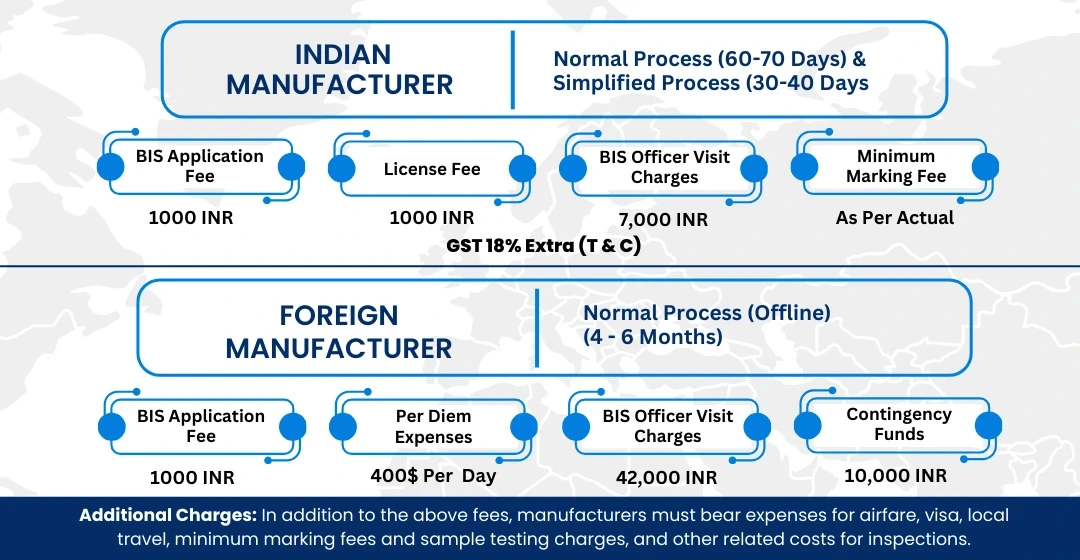
To Know The Process in Detail, Please Visit:
Under BIS Registration Products ISI and CRS
Conclusion
BIS certification for Room Air Conditioners under IS 1391
(Part 1): 2017 ensures that Unitary Air Conditioners meet critical standards
for performance, safety, and energy efficiency. This certification process
provides consumers with the assurance that the product is safe to use,
reliable, and environmentally friendly. For manufacturers, obtaining BIS
certification is not only a legal requirement but also an opportunity to boost
the product's reputation in the market. It ensures compliance with national
regulations and helps build consumer trust through the ISI mark. EVTL India
offers expert consultancy services to assist manufacturers through the BIS
certification process, handling all aspects including documentation, testing,
and compliance management, ensuring a smooth and efficient certification
process.