
BIS Certification for Steel Balls for Rolling Bearings IS 2898 (Part 1):2019
Steel balls are the core functional
elements in rolling bearings, making them indispensable in a wide range of
industrial and mechanical applications. Whether in automotive systems, heavy
machinery, electric motors, or high-speed turbines, these precisely engineered
spheres enable rotational movement, reduce friction, and carry significant
loads—often under high-speed or high-stress conditions.
Given their critical role, the Bureau of Indian Standards (BIS) mandates certification for steel balls used in rolling bearings under IS 2898 (Part 1):2019, which aligns with the international standard ISO 3290-1:2014. This BIS certification ensures that the steel balls conform to globally accepted standards of quality, performance, and safety.
Importance of Steel Balls
in Bearings
Steel balls are typically made from
high-grade materials such as chrome
steel (AISI 52100) or stainless
steel, known for their hardness, corrosion resistance, and fatigue
strength. Their performance determines the operational efficiency and life span
of rolling bearings.
A typical rolling bearing contains a set of steel balls positioned between an inner and outer ring. As the shaft rotates, the balls roll, reducing friction and distributing loads evenly. The precision, roundness, and strength of each ball are paramount; even the slightest deviation can compromise bearing efficiency or cause mechanical failure.
Overview of IS 2898 (Part
1):2019 / ISO 3290-1:2014
IS 2898 (Part 1):2019 is the Indian
Standard that governs the technical requirements for steel balls used in
rolling bearings. This standard is a modified adoption of ISO 3290-1:2014,
harmonizing domestic regulations with international norms while addressing
Indian manufacturing conditions and industrial needs.
The standard specifies the essential
characteristics that steel balls must meet to qualify for BIS certification:
By adhering to this standard, manufacturers can guarantee a level of precision and reliability necessary for demanding applications across automotive, aerospace, industrial machinery, and consumer products.
Why BIS Certification is
Mandatory
The BIS ISI certification, as per IS
2898 (Part 1):2019, is mandatory for manufacturers or importers of steel balls
used in rolling bearings in India. The ISI mark serves as proof that the
product conforms to standardized testing, manufacturing, and quality assurance
protocols.
Certification benefits include:
Test Methods and
Evaluation Criteria
The testing regimen for certification
is highly rigorous and covers multiple performance parameters:
Each test aims to validate that the
product can function reliably in dynamic environments where failure is not an
option.
Certification Process

To obtain BIS certification for steel
balls under IS 2898 (Part 1):2019, the manufacturer must follow a structured
process:
- Application Submission: Manufacturers submit their applications through the BIS portal, including technical specifications, factory details, and sample declarations.
- Product Testing: Samples are tested in BIS-approved laboratories for compliance with parameters such as sphericity, diameter, hardness, crushing strength, and surface quality.
- Factory Audit: BIS inspectors assess the manufacturing unit’s capability, quality control processes, and testing facilities to ensure consistent production standards.
- License Issuance: Upon successful testing and inspection, BIS grants a license to use the ISI mark on the product.
This process ensures that the product not only passes initial quality checks but also maintains ongoing compliance through surveillance audits and random sampling.
To Know The Process in Detail, Please Visit:
Under BIS Registration Products ISI and CRS
Documents Required for BIS Certification
To apply for BIS certification, manufacturers need to submit the following documents:
● Application form
● Manufacturing process details
● Quality control plan
● Test reports from BIS-approved laboratories
● Factory layout and equipment details
● Proof of business registration
● Product specifications and technical details
● Declaration of conformity to Indian standards
Additionally, manufacturers may be required to provide proof of compliance with environmental and safety regulations, depending on the specific type of product being certified.
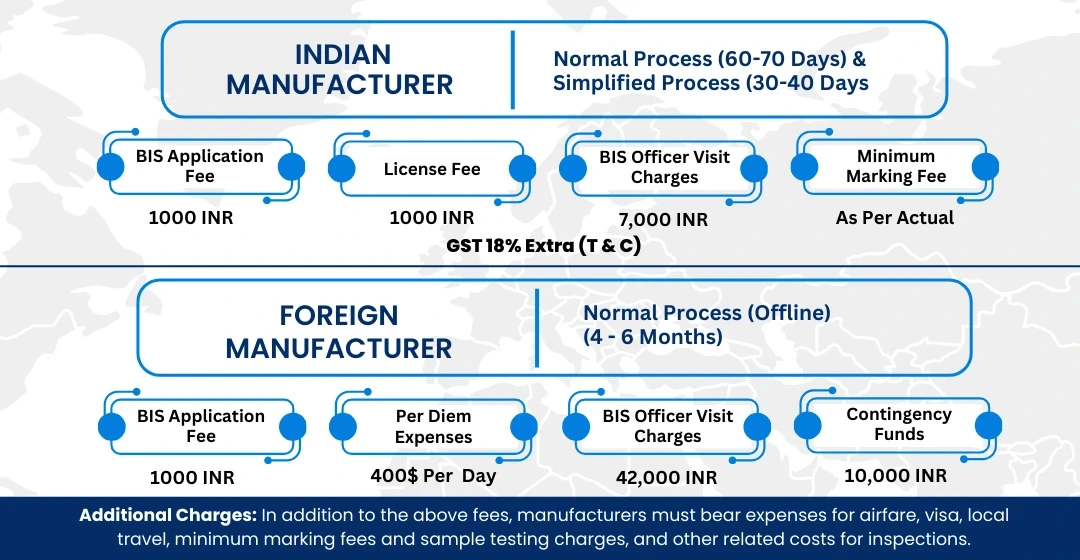
BIS ISI Mark Certification Costing And Timeline
Certification Validity and Renewal
The BIS license for steel balls is
generally valid for two years,
provided there are no significant changes in manufacturing methods or raw
materials. To continue using the ISI mark, the manufacturer must undergo
periodic audits and submit fresh test results during the renewal process.
BIS must re-evaluate any modification in ball size, material grade, or manufacturing setup to retain compliance status.
Conclusion
Steel balls may seem like a simple
product, but their engineering and performance impact the reliability of entire
mechanical systems. BIS certification under IS 2898 (Part 1):2019 / ISO 3290-1:2014 ensures these components
meet the strictest quality benchmarks for use in high-performance bearings.
For manufacturers, BIS certification
is a mark of precision and trust. For users, it guarantees durability,
operational safety, and reduced maintenance costs. In a world where machinery
runs on precision, certified steel balls are the silent heroes that keep the
wheels turning—literally.