BIS Certification for Surgical Face Masks IS 16289:2014
In the healthcare world, surgical face
masks play a crucial role in safeguarding both patients and healthcare
professionals. But ensuring these masks meet reliable quality standards isn’t
just a preference — it’s a necessity. This is where BIS certification comes in,
specifically under Indian Standard IS 16289: 2014.
Let’s break down what this means, why it matters, and how manufacturers can obtain the ISI Mark for surgical face masks.
What is IS 16289: 2014?
IS 16289:2014 is the Indian Standard
for surgical face masks, specifying the design, performance, and testing
requirements that these masks must meet. This standard ensures that surgical
masks offer adequate protection against fluids, particles, and microorganisms,
making them fit for use in medical settings.
Complying with IS 16289 helps ensure:
In short, it sets a benchmark for safety and quality.
Why is BIS Certification
Important?
The Bureau of Indian Standards (BIS) is India’s national standards body
responsible for ensuring that products meet the necessary safety and quality
requirements. For products like surgical masks, BIS operates under a mandatory certification scheme, meaning
manufacturers cannot legally sell surgical face masks in India without first
obtaining the ISI Mark certification for surgical face masks.
The ISI Mark is the official certification mark from BIS. When you see the ISI Mark on a product, it signals compliance with relevant Indian standards — in this case, IS 16289: 2014 for surgical face masks.
Benefits of ISI
Certification for Surgical Face Masks
Here’s why obtaining the ISI
certification for surgical face masks is essential:
● Market Access: Only ISI-certified masks
can be sold or distributed legally in India under this standard.
● Consumer Trust: Healthcare providers and
institutions look for the ISI Mark for surgical face masks as a sign of
reliability.
●Quality Assurance: Regular audits and
inspections ensure that the manufacturing process remains consistent and
aligned with IS 16289: 2014.
●Competitive Advantage: Certified products stand out in a crowded market where quality and safety matter most.
How to Get ISI Mark
Certification for Surgical Face Masks
Obtaining BIS certification for
surgical face masks involves the following steps:
- Application Submission: Submit the completed application form with necessary
documentation to BIS.
- Document Review: BIS evaluates the submitted documents to verify accuracy and
completeness.
- Factory Inspection: BIS officials conduct on-site inspections to assess manufacturing
processes and quality control systems.
- Sample Testing: Product samples are collected and tested at BIS-approved
laboratories to verify compliance with Indian standards.
- Certification Grant: Upon successful inspection and testing, the BIS issues the certification, allowing the use of the ISI Mark.
Documents Required for BIS Certification
To apply for ISI
Certification for surgical face masks, manufacturers must provide the following
documents:
● Completed application form
● Detailed manufacturing process
information
● Quality control plans and test
reports
● Factory layout and equipment
details
● Product specifications and
technical details
● Business registration proof
● Declaration of conformity to
Indian standards
BIS Documents For Domenstic and Foreign Manufacturer Check
BIS ISI Mark Certification Costing And Timeline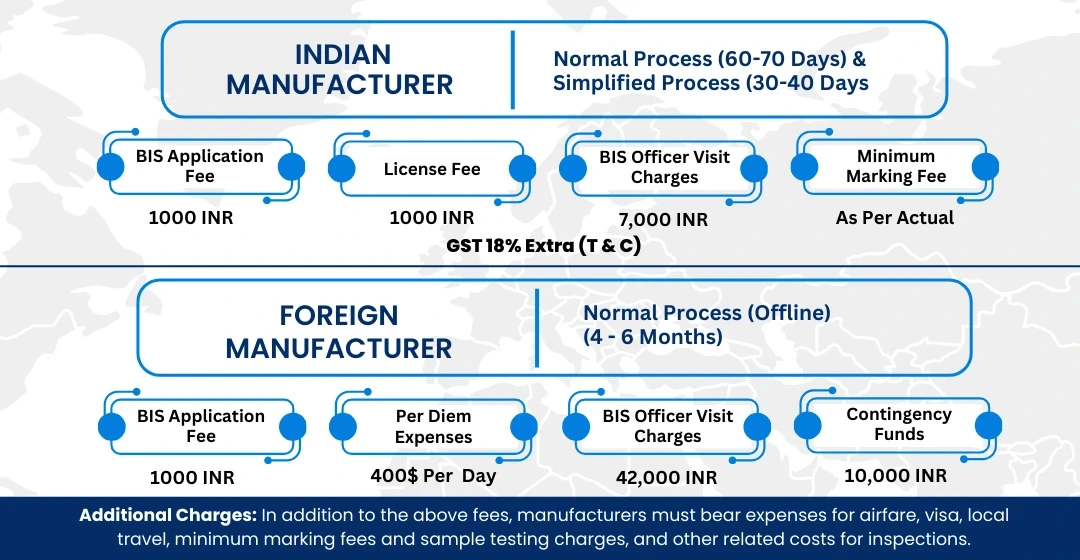
To Know The Process in Detail, Please Visit:
Under BIS Registration Products ISI and CRS
Conclusion
The Indian Standard for surgical face
masks (IS 16289: 2014) is not just a technical specification — it’s a trust mark for
healthcare quality. Obtaining the ISI Mark certification for surgical face
masks reassures buyers and users that the product has passed stringent testing
and adheres to national safety benchmarks.
For manufacturers, staying compliant
is not only a legal requirement but also a powerful way to position themselves
as responsible and quality-focused players in the healthcare industry.
If you are a manufacturer or
distributor, ensure your products carry the ISI Mark for surgical face masks;
it’s your gateway to regulatory approval and market confidence.