Implementation Guideline for Household, Commercial and Similar Electrical Appliances IS 302 (Part 1) : 2024
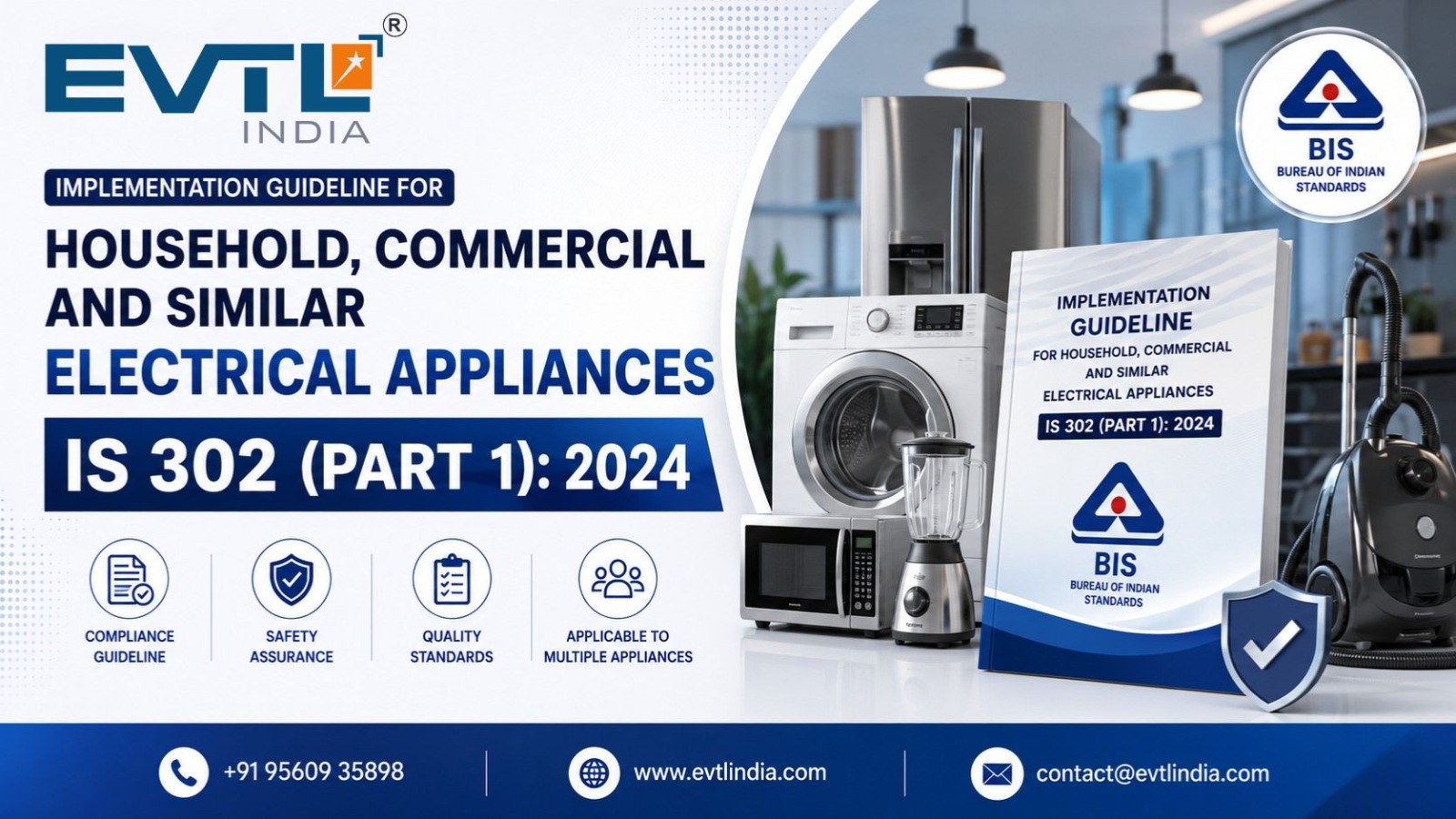
The Department for Promotion of Industry and Internal Trade (DPIIT) has introduced a significant update to the safety requirements for household and similar electrical appliances in India. The existing standard, IS 302 (Part 1): 2008 – Safety of Household and Similar Electrical Appliances: Part 1 – General Requirements (Sixth Revision), has been revised and replaced by IS 302 (Part 1): 2024/IEC 60335-1:2020 – Household and Similar Electrical Appliances – Safety: Part 1 – General Requirements (Seventh Revision).
To facilitate a smooth transition, both standards will remain valid concurrently until 23 February 2026. After this date, IS 302 (Part 1): 2008 will be withdrawn, and compliance with IS 302 (Part 1): 2024 will become mandatory for certification and market access in India.
Overview of the Quality Control Order (QCO), 2024
The Quality Control Order (QCO), 2024 mandates BIS Certification for household, commercial, and similar electrical appliances intended to operate at:
- Up to 250V Single-Phase Alternating Current
- Up to 415V Three-Phase Alternating Current
The QCO applies to a wide range of electrical appliances sold in the Indian market. However, products already covered under separate BIS Quality Control Orders are excluded from this notification. The detailed list of excluded products is provided in Annexure-I of the implementation guideline.
The objective of the QCO is to improve product safety, strengthen consumer protection, and ensure that electrical appliances comply with updated Indian and international safety requirements.
Revised Safety Standard: IS 302 (Part 1): 2024
The revised standard aligns Indian requirements with IEC 60335-1:2020, the internationally recognized safety standard for household and similar electrical appliances.
Concurrent Running Period
| Standard | Status |
| IS 302 (Part 1): 2008 | Valid until 23 February 2026 |
| IS 302 (Part 1): 2024 / IEC 60335-1:2020 | Effective immediately |
| After 23 February 2026 | Only IS 302 (Part 1): 2024 will remain applicable |
This transition period allows manufacturers sufficient time to update product designs, testing procedures, documentation, and certification requirements.
Scope of Products Covered
The revised standard applies to various household, commercial, and similar electrical appliances including:
- Electric kitchen appliances
- Water heaters
- Electric kettles
- Food preparation appliances
- Vacuum cleaners
- Personal care appliances
- Commercial cooking equipment
- Cleaning appliances
- Heating appliances
- Other electrical appliances covered under the IS 302 series
Where applicable, compliance with relevant IS 302 (Part 2) standards is also required.
What Manufacturers Need to Know
Manufacturers can continue applying under either the existing or revised standard during the concurrent running period.
Applications Based on IS 302 (Part 1): 2008: If the relevant appliance standard exists under the IS 302 (Part 2) series:
- Compliance with both IS 302 (Part 1): 2008 and the applicable Part 2 standard is required.
If no relevant Part 2 standard exists:
- Certification may be granted based solely on IS 302 (Part 1): 2008.
Applications Based on IS 302 (Part 1): 2024: If the relevant product standard exists under the IS 302 (Part 2) series:
- Compliance with both IS 302 (Part 1): 2024 and the applicable Part 2 standard is mandatory.
If no relevant Part 2 standard exists:
- Certification may be granted based on IS 302 (Part 1): 2024 together with relevant IEC requirements.
Key Revisions Introduced in IS 302 (Part 1): 2024
The updated standard includes several important changes designed to improve safety and harmonize Indian requirements with international practices.
- Alignment with IEC 60335-1:2020:The revised standard adopts internationally accepted safety requirements and testing methodologies.
- Revised Licensing Scope:Changes have been introduced regarding product coverage and certification applicability under BIS licensing schemes.
- Updated Inspection and Testing Requirements:The implementation guideline introduces revised testing procedures and inspection mechanisms to ensure continuous product compliance.
- Modified Marking Requirements: Manufacturers must update product labels, ratings, warnings, user instructions, and traceability information according to the revised standard.
- Updated Grouping Guidelines:New grouping criteria have been introduced for certification purposes to improve consistency and regulatory oversight.
Key Steps for Compliance
Manufacturers should take the following actions before the end of the concurrent period:
Review Product Applicability:Determine whether the product falls under:
- IS 302 (Part 1): 2024 only
- IS 302 (Part 1): 2024 along with an applicable Part 2 standard
Conduct Gap Analysis:Compare existing compliance under IS 302 (Part 1): 2008 with the new requirements of IS 302 (Part 1): 2024.
Update Product Design and Documentation:Revise:
- Product specifications
- User manuals
- Safety instructions
- Product markings
- Technical files
Obtain Updated Test Reports:Manufacturers must submit test reports from BIS-recognized laboratories covering any additional requirements introduced in the revised standard.
Submit BIS Certification Application:Applications can be filed under either standard until 23 February 2026. Early migration is recommended to avoid certification delays. Prepare for BIS Verification: BIS officials will verify implementation during factory inspections and surveillance activities.
Guidelines for Existing Licence Holders
Existing voluntary BIS licence holders under IS 302 (Part 2) or related appliance standards have the following options:
Option 1:Switch the existing licence to IS 302 (Part 1): 2008 during the transition period.
Option 2: Apply for a separate licence under IS 302 (Part 1): 2008.
In both cases:
- The licence scope will remain unchanged.
- No additional testing may be required.
- No fresh factory inspection may be necessary.
However, migration to IS 302 (Part 1): 2024 will be mandatory before the end of the concurrent running period.
Implementation Timeline
| Activity | Timeline |
| Introduction of IS 302 (Part 1): 2024 | Effective Immediately |
| Concurrent Running of 2008 & 2024 Standards | Up to 23 February 2026 |
| Submission under Either Standard | Allowed During Concurrent Period |
| Mandatory Compliance with IS 302 (Part 1): 2024 | After 23 February 2026 |
| Withdrawal of IS 302 (Part 1): 2008 | 23 February 2026 |
Significance of the Update
The implementation of IS 302 (Part 1): 2024 offers several benefits:
- Improved electrical safety requirements
- Better protection against fire and electric shock risks
- Alignment with global safety standards
- Enhanced product quality and reliability
- Greater consumer confidence
- Stronger regulatory compliance framework
- Improved international acceptance of certified products
Conclusion
The implementation of IS 302 (Part 1): 2024/IEC 60335-1:2020 marks an important step toward modernizing India's electrical appliance safety framework. With the concurrent running period ending on 23 February 2026, manufacturers should begin transitioning to the revised standard as early as possible. Timely compliance, updated testing, revised documentation, and BIS certification alignment will help businesses avoid disruptions while ensuring product safety, regulatory compliance, and continued access to the Indian market.